
India's precision strikes using an array of weapon systems and missiles on eight key installations ranging from air defence systems to radar sites and command centres of the Pakistani military forced Islamabad to urge New Delhi to end the hostilities, the sources said.
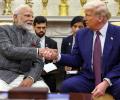
A US lawmaker and former officials warn that President Trump's policies are damaging the strategic partnership between the United States and India, potentially driving India closer to China and Russia.

The US intelligence assessment highlights Pakistan's near-certain procurement of weapons of mass destruction-applicable goods from foreign suppliers, primarily through Chinese support.
Trump said he had a series of phone calls on trade with both India and Pakistan.
US President Donald Trump announced a deal with Pakistan to develop its oil reserves, suggesting Pakistan might sell oil to India in the future.

Singh said New Delhi has "redesigned and redefined" its strategy and response to terrorism and that possible dialogue with Islamabad will be only on terrorism and PoK.

India has strongly rejected Pakistan's claims on Kashmir, calling it a Union Territory and dismissing the Pakistan Army Chief's statement about it being the country's "jugular vein." India also rejected Pakistan's claim that Tahawwur Rana, a Mumbai terror attack accused, is a Canadian citizen and that it has nothing to do with him. India's External Affairs Ministry spokesperson stated that Pakistan's reputation as the "epicentre" of global terrorism will not diminish. Rana's extradition is a reminder that Pakistan needs to bring other perpetrators of the Mumbai terror attacks to justice, according to India.

Prime Minister Narendra Modi and Chinese President Xi Jinping are expected to hold bilateral meetings on the sidelines of the SCO summit in Tianjin, as both nations look to strengthen ties amid global trade tensions.

The disbursement of the second tranche comes on a day when the International Monetary Fund is holding virtual discussions on Pakistan's upcoming budget, as the visit of its mission to Islamabad was delayed due to security concerns in the region.
'What the Americans want is to destabilise Iran. For destabilising Iran, you need access. 'One access is through Iraq. The other access is through Pakistan.'
'India is too important to the United States for there to be any kind of a permanent bump in the relationship.'

India-US relations, like Rome, were not built in a day, nor can they be demolished in a day.
All said and done, when the new global order emerges, India can only remain with the democracies, asserts Ambassador T P Sreenivasan.

Pakistan's former foreign minister Bilawal Bhutto-Zardari on Monday said his country will go to war if India denies Islamabad its fair share of water under the Indus Waters Treaty (IWT).

Foreign Secretary Shyam Saran arrived in Islamabad on Wednesday to discuss the progress in the composite dialogue process as well as to set the course of the peace maneuvers.
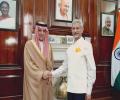
The Saudi statement came as tensions soared significantly, with Pakistan claiming that its three airbases were targeted by Indian missiles and drones early Saturday.
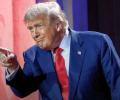
Since May 10, when Trump announced on social media that India and Pakistan had agreed to a "full and immediate" ceasefire after a "long night" of talks mediated by Washington, he has repeated his claim on several occasions.
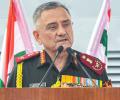
Possible convergence of interest among China, Pakistan, and Bangladesh may result in serious implications for India's stability and security dynamics, Chief of Defence Staff General Anil Chauhan said on Tuesday.
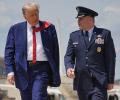
He then went on to say that, however, he won't get a Nobel Peace Prize for any of his efforts.
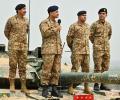
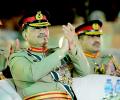
United States President Donald Trump will host Pakistan Army chief Asim Munir for lunch at the White House on Wednesday.

He said Prime Minister Narendra Modi has made it "very clear" that any talks with Pakistan will be only on terror.
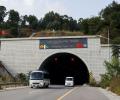
The announcement on expansion of CPEC was made following a meeting among Chinese Foreign Minister Wang Yi, his Pakistani counterpart Ishaq Dar and Afghanistan's Acting Foreign Minister Amir Khan Muttaqi in Beijing, according to a Pakistani readout.
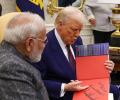
'The current strain in the relationship is serious and likely to be long lasting.' 'Even if Trump suddenly changes his attitude toward India -- which he is entirely capable of doing -- it is unlikely that New Delhi will be able to pick up the pieces and respond as if nothing has happened.'

'The background for the Saudi-Pakistan agreement is the fact that the regional security order has collapsed due to the Israeli attack on Doha.' 'The Americans have largely abandoned their security guarantee for West Asia and the region has no choice but to look at alternatives.'
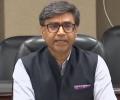
India has accused Pakistan of breaching an understanding reached earlier on Saturday to stop military actions. Foreign Secretary Vikram Misri said there have been repeated violations of the understanding since the evening, and that the Indian armed forces are giving an appropriate response.
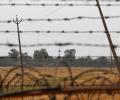
The United States on Thursday said it supports India's right to defend itself and its fight against terrorism as US Defence Secretary Pete Hegseth dialled Defence Minister Rajnath Singh amid rising tensions between India and Pakistan over the Pahalgam terror attack.

Pakistan Prime Minister Shehbaz Sharif has called on "brotherly" countries, including Saudi Arabia, to urge India to de-escalate tensions after the Pahalgam terror attack that killed 26 people. Sharif met with ambassadors from Saudi Arabia, the UAE, and Kuwait, reiterating Pakistan's commitment to peace in South Asia. He rejected India's accusations linking Pakistan to the attack, emphasizing Pakistan's own history as a victim of terrorism. The meeting comes amidst heightened tensions between the two countries.
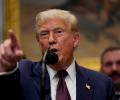
India would neither succumb to the Americans on issues of national security, such as its defence ties with Russia, nor cede ground on its domestic interests in the agriculture and dairy sectors.
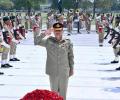
Sections in the US State Department and Pentagon have always felt more comfortable dealing with all powerful Pakistani generals instead of elected civilians, points out Rana Banerji, who headed the Pakistan desk at RA&W.
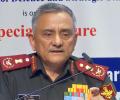
Pakistan's decision to talk to India on May 10 stemmed from realisation that it will suffer more if its operation continues, Gen Chauhan said.
'We want to give our undivided attention and energy to the success of SAARC,' he said.
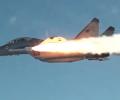
The Directors General of Military Operations of India and Pakistan firmed up the arrangement on stopping military actions on May 10 after four days of fierce offensives between the two sides that triggered fears of a wider conflict.

'I am pleased to announce the Governments of India and Pakistan have agreed to an immediate ceasefire and to start talks on a broad set of issues at a neutral site.'
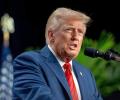
Trump said that leaders in India and Pakistan are "great leaders" and "they understood, and they agreed, and that all stopped".
Foreign secretaries of India and Pakistan -- Nirupama Rao and Salman Bashir -- have begun their much-anticipated meeting in Islamabad on Thursday, even as Indian officials have said that New Delhi is "looking at these talks in a positive and constructive manner".
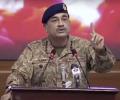
Asim Munir and his brand of short-sighted army officers give no inkling of paying heed, changing course or learning lessons from the past, observes Rana Banerji, who headed the Pakistan desk at RA&W.
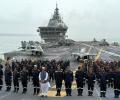
In an interaction with naval warriors on board aircraft carrier INS Vikrant off Goa, Singh sent a stern warning to Islamabad saying India will not hesitate to use the methods to deal with terrorism that Pakistan cannot even think of.
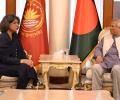
Bangladesh has demanded a public apology and compensation from Pakistan for the 1971 atrocities, raising "historically unresolved issues" during the first foreign secretary-level talks between the two countries in 15 years. Dhaka also asked Islamabad to pay USD 4.3 billion as its share from the combined assets at the time of East Pakistan's split from West Pakistan in 1971 to form an independent Bangladesh.
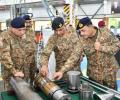
'Pakistan's army has got a streak of democracy. It is more democratic than the country.'

The post further read that "at a moment of heightened regional turbulence", President Trump "demonstrated great strategic foresight and stellar statesmanship through robust diplomatic engagement with both Islamabad and New Delhi," Dawn reported.
